
Educational Resource
Understanding Tier 1 and Tier 2
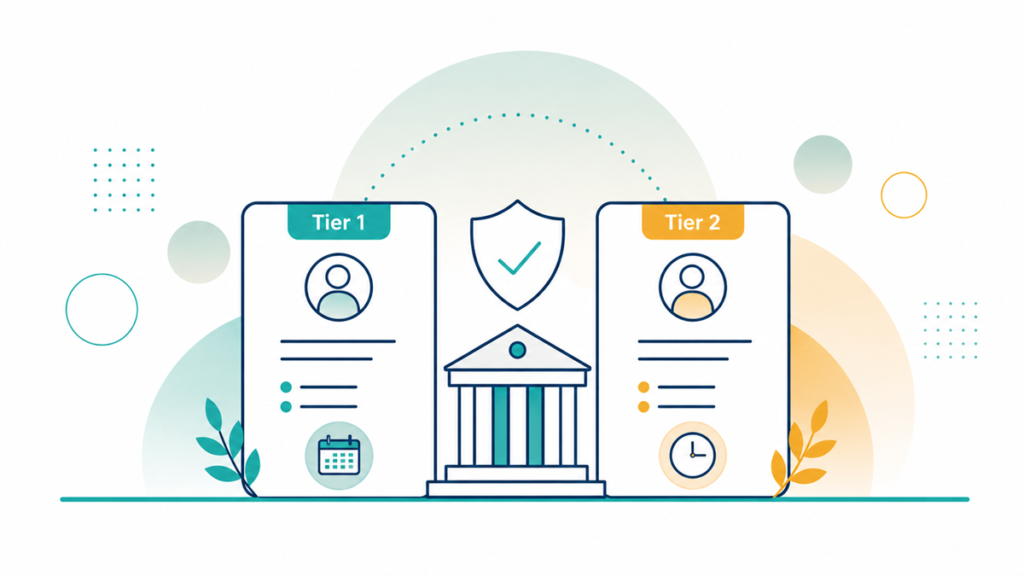
CTPF members contribute to the same pension system, but Tier 1 and Tier 2 membership rules create different paths to retirement security, a divide members should understand and work to repair.
What You’ll Learn:
- What Tier 1 and Tier 2 mean
- Key differences in retirement rules
- Why Tier 2 offers less protection
- How Tier 2 affects CTPF’s future
- Why PAG supports repealing Tier 2
The Chicago Teachers’ Pension Fund is a defined benefit pension system. That means members earn a lifetime retirement benefit based on a formula, not on individual investment returns.
But not all CTPF members are covered by the same pension rules.
Since 2011, CTPF members have been divided into two groups: Tier 1 and Tier 2. Both groups contribute to the same pension fund. Both groups serve students, schools, and communities. However, the rules that govern retirement age, salary calculations, pension increases, and long-term retirement security are different.
PAG believes members deserve to understand these differences clearly. PAG also believes Tier 2 is unfair because it leaves newer educators more vulnerable in retirement and creates unequal membership within the same pension system.
One of PAG’s goals is to repeal Tier 2 and restore equal membership for all CTPF members.
What Are Tier 1 and Tier 2?
Tier 1 and Tier 2 refer to two different sets of pension rules based largely on when a member first joined CTPF or a qualified reciprocal pension system.
According to CTPF’s official Tier 1 vs. Tier 2 pension comparison, Tier 1 generally applies to members who joined CTPF or a qualified reciprocal system before January 1, 2011. Tier 2 applies to members who joined CTPF on or after January 1, 2011.
The basic pension formula is similar, but several important rules are different. Those differences can affect when a member can retire, how their final average salary is calculated, how much salary counts toward their pension, and how their pension increases after retirement.
In plain English: Tier 2 members are part of the same pension system, but they do not receive the same level of protection as Tier 1 members.
Why Tier 2 Was Created
Tier 2 was created by Illinois lawmakers in 2010 as part of a broader effort to reduce future pension costs. The change applied to newer public employees, including educators who began CTPF-covered employment on or after January 1, 2011.
Supporters of Tier 2 framed it as a cost-saving measure. But pension advocates, unions, and many educators have raised serious concerns about the fairness and long-term impact of creating a second, less protective pension tier.
The Chicago Teachers Union has described Tier 2 as a system that divides members and undermines retirement security. In its article, “You deserve your retirement. Let’s fix Tier Two and anti-teacher social security provisions,” CTU argues that newer employees were placed into second-tier pensions even though they are doing the same public service work.
PAG shares the concern that Tier 2 creates an unfair divide. The cost of pension funding challenges should not be shifted onto newer educators through weaker retirement protections.
CTPF Is Still a Defined Benefit Pension System
It is important to be clear: CTPF remains a defined benefit pension system.
A defined benefit pension provides retirement income based on a formula. That formula generally includes years of service, final average salary, and a pension multiplier. CTPF’s Pension Fundamentals explains that defined benefit pensions are not based on individual market returns and are designed to provide guaranteed retirement income.
This matters because defined benefit pensions are different from defined contribution plans, such as 401(k)s or 403(b)s. In a defined contribution plan, retirement income depends on contributions, investment choices, market performance, fees, and how long the money lasts.
A defined benefit pension is intended to provide a more stable lifetime retirement income.
However, Tier 2 created a less protective structure inside the defined benefit system. That is why PAG believes members need to understand the difference between preserving CTPF as a defined benefit plan and fixing the unequal treatment created by Tier 2.
Difference #1: Retirement Age
One of the biggest differences between Tier 1 and Tier 2 is retirement age.
Tier 1 members may qualify for an unreduced pension earlier, depending on age and years of service. Under CTPF’s comparison, Tier 1 members may qualify for an unreduced pension at age 62 with 5 years of service, age 60 with at least 20 years of service, or age 55 with enough service credit.
Tier 2 members generally must wait until age 67 with at least 10 years of service to receive an unreduced pension. A reduced pension may be available at age 62 with at least 10 years of service.
In plain English, many Tier 2 educators must work longer before they can receive their full pension.
This difference matters. A teacher who begins working in their early twenties may have to work more than four decades to reach an unreduced Tier 2 retirement age. Chalkbeat has reported that educators and unions are concerned that Tier 2’s later retirement age may affect teacher recruitment and retention, especially during a time when schools are already facing staffing challenges.
PAG believes educators should not be divided into unequal retirement paths simply because they began their service after a certain date.
Difference #2: Final Average Salary
A member’s pension is based partly on their final average salary. Tier 1 and Tier 2 calculate that salary differently.
For Tier 1 members, CTPF calculates the final average salary using the average of the highest four consecutive years of salary within the ten years before retirement.
For Tier 2 members, CTPF uses the average of the highest eight consecutive years of salary within the ten years before retirement.
In plain English, Tier 2 averages the salary over a longer period of time. That can lower the final average salary used to calculate the pension.
This matters because even small differences in final average salary can affect lifetime retirement income. A lower final average salary can mean a lower pension benefit.
PAG believes this is one of the ways Tier 2 creates a less protective retirement structure for newer educators.
Difference #3: Pensionable Salary Cap
Tier 2 members are also subject to a pensionable salary cap.
The salary cap does not necessarily limit how much a member can earn while working. Instead, it limits how much salary can be counted toward pension contributions and pension calculation.
CTPF explains that the Tier 2 salary cap limits the amount of salary used to calculate the pension. For 2026, CTPF lists the final average salary cap used to calculate Tier 2 pensions at $129,192.26, with future increases tied to the lesser of 3% or one-half of the Consumer Price Index increase.
In plain English: if a Tier 2 educator earns more than the pensionable salary cap, not all of that salary counts toward their pension.
PAG believes this cap creates another unequal limit on Tier 2 members’ retirement security.
Difference #4: Annual Pension Increases
Annual pension increases help retirees keep up with rising costs over time. Tier 1 and Tier 2 members receive different increases.
Tier 1 retirees receive a 3% compounded annual pension increase beginning one year after retirement or at age 61, whichever comes later.
Tier 2 retirees receive the lesser of 3% or one-half of the increase in the Consumer Price Index. That increase begins one year after retirement or at age 67, whichever comes later.
In plain English: Tier 2 retirees may receive smaller annual increases, and they may have to wait longer before those increases begin.
This is especially important because retirement can last many years. Smaller annual increases can make retirees more vulnerable to inflation, rising healthcare costs, housing expenses, and other financial burdens.
PAG believes this is one of the clearest ways Tier 2 leaves newer educators more exposed over the long term.
Why Social Security Matters in This Conversation
Many CTPF members do not contribute to Social Security through their CTPF-covered teaching employment. Instead, they contribute to the pension system.
That makes the pension even more important.
Chalkbeat has reported that one major concern with Tier 2 is whether lower-tier benefits could eventually fall below the level provided by Social Security. This is often discussed as a “Safe Harbor” issue. The basic concern is that public pension benefits for employees who are not covered by Social Security must meet federal standards.
But PAG believes the issue is larger than minimum compliance.
Even if lawmakers make changes to address federal compliance concerns, that does not necessarily fix the fairness problem. Tier 2 members are still working under a less protective structure than Tier 1 members.
PAG believes Tier 2 is not only a technical issue. It is a fairness issue, a workforce issue, and a retirement security issue.
Why Tier 2 Matters for All CTPF Members
Tier 2 is not only a new-teacher issue. It affects the future of the entire pension system.
CTPF is one pension fund. Tier 1 and Tier 2 members are part of the same system. When members are divided into unequal tiers, it can weaken trust, reduce solidarity, and make it harder for members to understand and defend the value of the defined benefit pension system.
A strong pension system depends on confidence. Members need to believe the system is fair, stable, transparent, and worth protecting.
If newer educators are asked to contribute to the same system while receiving weaker protections, that raises serious concerns about fairness, recruitment, retention, and long-term retirement security.
PAG believes protecting Tier 2 members helps protect the future of CTPF as a whole.
PAG’s Position: Repeal Tier 2 and Restore Equal Membership
PAG believes Tier 2 should be repealed.
Tier 2 members contribute to the same pension system and serve the same public education mission, but they face a later retirement age, a longer final average salary calculation, a pensionable earnings cap, and a weaker annual increase structure.
PAG believes this creates unequal membership.
Repealing Tier 2 is about restoring fairness. It is about protecting educators who are currently working, future educators who will enter the profession, and the long-term strength of the defined benefit pension system.
PAG’s goal is equal membership: one pension system that protects all CTPF members fairly, regardless of when they began their service.
The Bottom Line
Tier 1 and Tier 2 members are part of the same pension system, but they do not receive the same retirement protections under current law.
PAG believes this divide is unfair and unsustainable.
Tier 2 members deserve the same dignity, security, and respect as the educators who came before them. Repealing Tier 2 is not just about changing a pension formula. It is about restoring fairness, strengthening the teaching profession, and protecting the promise of a defined benefit pension for all CTPF members.
Latest from PAG
Recent blog posts, updates, educational resources, event recaps, and media from Pension Advocacy Group.

news & updates
September CTPF Board Watch
Get a closer look at the September CTPF meetings, including contribution discipline, investment consultant oversight, administrative expenses, tax levy transparency, and access to historical records. Read Post →

advocacy & Legislation
Staying in the Fight
August was a full month, with legislator education efforts, a brief conversation with Mayor Brandon Johnson, CTPF investment consultant updates, health insurance developments, and retiree advocacy meetings. Read Post →

news & updates
Why PAG Is Asking Questions
We’re asking hard questions about CTPF’s funded ratio, dedicated tax levy revenue, investment consultant decisions, health insurance, and property tax timing. Read More →
advocacy & legislation
2026 Legislative Fact Sheet
Check out our plain-language summary of Illinois pension protections, Tier 2 concerns, and PAG’s legislative priorities for CTPF members. Download Fact Sheet →

news & updates
What It Means to Leave People Behind
From the Amerasian Homecoming Act to Tier 2, she connects personal memory, public policy, and PAG’s next chapter. Read Post →

PAG NEWS
Unimaginable Joy
Tina reflects on a Yukon trip that helped her realize her work to protect earned benefits did not have to end after her time as a CTPF Trustee – it could take a new shape through PAG. Read Post →
Take Action Now
Stay Informed. Stay Protected.
Subscribe to the newsletter for timely updates on pension policy, board activity, and the work PAG is doing to protect and strengthen defined-benefit systems.